Welcome Back to School Bag Topper V2
For educators, PTA organizers, small business owners, and creative professionals preparing for the new academic year, Welcome Back to School Bag Topper V2 offers a streamlined, print-ready solution for packaging first-day treats—without requiring design expertise or custom software. Unlike generic clipart bundles or one-size-fits-all templates, this resource is built around a specific physical format: 5.5" × 5" treat bag toppers, optimized for standard 8.5" × 11" cardstock or sticker paper. Its utility lies not in novelty, but in executional clarity—making it a quietly effective tool for anyone managing volume, consistency, and presentation across classroom gifts, vendor giveaways, or branded community outreach.
Purpose and Practical Scope
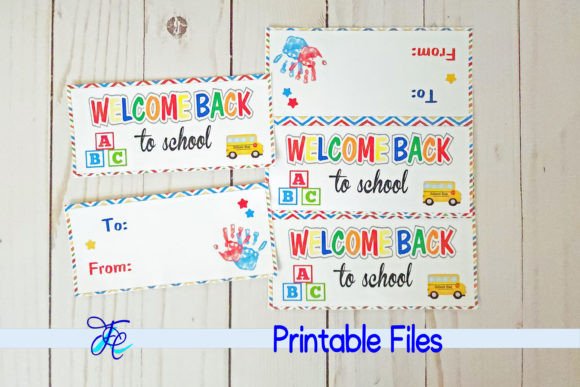
The core function of Welcome Back to School Bag Topper V2 is structural and communicative: it provides two identical toppers per printed page, designed to sit cleanly atop cellophane or kraft treat bags filled with cookies, granola bars, pencils, or other welcome items. Each topper includes space for personalization—typically a child’s name or grade level—and features clean typography, balanced negative space, and school-appropriate visuals (e.g., apples, books, pencils, or subtle geometric motifs). It doesn’t aim to replace full branding systems, nor does it attempt to serve as a curriculum supplement. Instead, it fills a narrow but frequently overlooked gap: the need for professional-looking, scalable, low-friction packaging accents that align with seasonal timing and logistical constraints.
Design Consistency and Print Reliability
This version improves on earlier iterations through tighter alignment between digital file and physical output. The PDF is constructed at exact scale—no scaling adjustments needed beyond confirming “Actual Size” (100% scale) in printer settings. That detail matters: mis-scaled toppers often result in cropped text, uneven margins, or awkward fit on standard 5.5" × 5" bags, especially when printed on thicker cardstock. Users who’ve tested Welcome Back to School Bag Topper V2 report fewer trimming corrections compared to similar assets where bleed or margin assumptions weren’t clearly defined.
Color fidelity remains dependent on hardware—home inkjet printers may render blues slightly cooler or yellows less saturated than intended, and monitor calibration affects on-screen preview accuracy. However, the design avoids fine gradients or ultra-thin lines that commonly break down at lower resolutions. Solid-color backgrounds, bold sans-serif fonts, and high-contrast text ensure legibility even with modest ink coverage or minor registration shifts during cutting.
Usability Across Real Workflows
In practice, Welcome Back to School Bag Topper V2 integrates most smoothly into workflows where speed, repeatability, and minimal post-printing labor are priorities. A third-grade teacher preparing 24 student bags can print four pages (eight toppers), trim them using a guillotine paper cutter in under three minutes, and attach each with double-sided tape or glue dots. A local bakery offering “First Day Cookie Kits” can print on matte sticker paper, apply directly to pre-filled bags, and maintain visual cohesion across 100+ units without outsourcing design or paying per-unit print fees.
Freelance designers sometimes use it as a baseline for client-facing proposals—customizing colors or adding school logos in vector-editable layers (if provided in layered source files, though the current release is PDF-only). Educators running summer enrichment programs have adapted the layout for “Welcome Back from Break” variations by hand-writing names or using label printers for variable data—demonstrating flexibility within its fixed dimensions.
Quality and Long-Term Value Considerations
Because Welcome Back to School Bag Topper V2 is delivered as a single PDF file—not a subscription, app, or editable online builder—its value is tied to immediate usability and reusability. There are no recurring costs, login requirements, or compatibility dependencies beyond Adobe Reader or a standard PDF viewer. Once downloaded, it can be printed year after year, adjusted for different grade levels or themes via manual annotation, or archived alongside other seasonal assets.
That said, it’s not a modular system. You won’t find alternate layouts (e.g., vertical orientation, bilingual versions, or ADA-compliant font variants) in this release. Nor does it include instructions for die-cutting machines or commercial press specifications. Its reliability comes from constraint: knowing exactly what you’re getting—and what it’s meant to do—reduces decision fatigue and setup time. For users who prioritize predictability over customization breadth, that’s an asset, not a limitation.
Audience Fit and Strategic Use Cases
Welcome Back to School Bag Topper V2 suits professionals whose goals center on efficiency, consistency, and audience resonance—not visual experimentation. School administrators coordinating district-wide welcome kits benefit from uniformity across campuses. Small-batch stationery sellers bundling teacher appreciation sets can include these toppers as value-adds without increasing production complexity. Bloggers creating printable back-to-school resource roundups often feature it because it solves a tangible problem with zero learning curve.
It’s less suited for agencies building comprehensive brand launches or educators needing multilingual, accessibility-optimized, or interactive elements (e.g., QR codes linking to welcome videos). Those needs require more adaptable formats—SVG, layered PSD, or web-based generators—but come with steeper setup time and higher error potential in execution.
Recommendations for Best Results
- Use white 8.5" × 11" cardstock (65–110 lb weight) for rigidity and clean folding; avoid glossy finishes if attaching with adhesive dots, as they may slide before setting.
- Test one page first—verify alignment, color balance, and cut-line accuracy before printing bulk runs. Adjust printer brightness/contrast if text appears washed out.
- Cut with precision tools: A rotary trimmer or self-healing mat + craft knife yields cleaner edges than scissors, especially along straight borders. Slight rounding of corners (0.125") prevents snagging on bag handles.
- Store unused prints flat in a dry, dark place—cardstock can curl in humidity, affecting adhesive application later.
Final Assessment
Welcome Back to School Bag Topper V2 succeeds not by reinventing the category, but by refining it. It acknowledges real-world variables—printer variance, time pressure, material limitations—and builds around them. Its strength is in quiet competence: predictable sizing, straightforward implementation, and visual appropriateness for its stated context. For anyone managing back-to-school logistics at scale—or simply aiming to make a thoughtful first impression without overengineering the process—it delivers measurable utility with minimal overhead. It won’t replace strategic planning or relationship-building, but it removes one friction point that otherwise accumulates across dozens of individual tasks. In practical terms, that’s often where meaningful efficiency gains begin.